

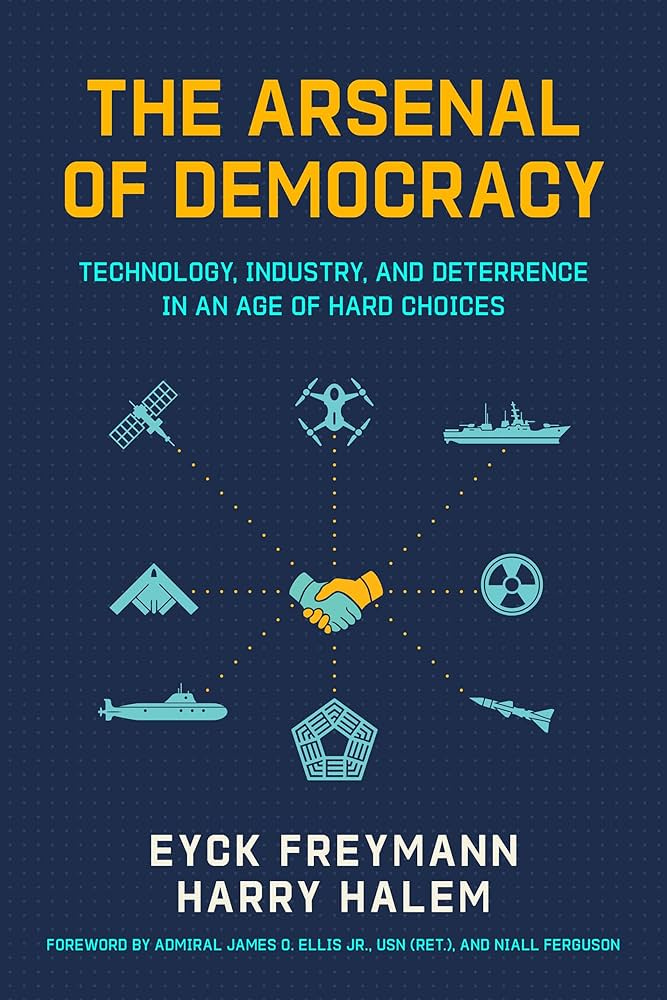
I’m thrilled to announce that my new book with Harry Halem—The Arsenal of Democracy: Technology, Industry, and Deterrence in an Age of Hard Choices—is out today, with a Foreword by Adm. James O. Ellis Jr. and Niall Ferguson.
Gary Roughead, former U.S. Navy Chief of Naval Operations and Commander of the US Pacific Fleet, calls it “by far the best appraisal of deterring and, if necessary, prevailing in a naval and air conflict in the Indo-Pacific.”
The book is a historically grounded guide to deterring war with China through industrial production, emerging military technologies, institutional reform, and cooperation with allies.
We’re hoping it will become a standard reference text for students, policymakers, investors, and defense tech industry leaders.
Thanks to generous funding from the Hoover Institution, the book is freely downloadable. If you’d like a hard copy, you can buy one at the Amazon link here:
Launch details
Over the past two months, we have soft-launched the book through extensive private and semi-public engagement with policymakers in allied countries.
The reception has been incredibly positive. We will continue to talk about the book in public and private events in the coming weeks as the final text of the 2026 National Defense Authorization Act comes together.
Here’s me and Harry discussing the book in Washington at a closed event in September, in conversation with Adm. Ellis, the former U.S. STRATCOM commander.
We had a closed event today at the London School of Economics and more programming coming in Washington later this month. More details to follow on our Stanford campus launch on November 20, moderated by Stephen Kotkin.
In future weeks, the Integrated Strategy substack will dive more deeply into the book’s specific findings and recommendations. Today, just posting this high-level overview of what the book covers:
About the book
The US military stands at a moment of profound risk and uncertainty. China and its authoritarian partners have pulled far ahead in defense industrial capacity. Meanwhile, emerging technologies are reshaping the character of air and naval warfare and putting key elements of the US force at risk. To prevent a devastating war with China, America must rally its allies to build a new arsenal of democracy. But achieving this goal swiftly and affordably involves hard choices.
The Arsenal of Democracy is the first book to integrate military strategy, industrial capacity, and budget realities into a comprehensive deterrence framework. While other books explain why deterrence matters, this book provides the detailed roadmap for how America can actually sustain deterrence through the 2030s—requiring a whole-of-nation effort with coordinated action across Congress, industry, and allied governments.
Rapidly maturing technologies are already reshaping the battlefield: unmanned systems on air, land, sea, and undersea; advanced electronic warfare; space-based sensing; and more. Yet China’s industrial strengths could give it advantages in a protracted conflict. The United States and its allies must both revitalize their industrial bases to achieve necessary production scale and adapt existing platforms to integrate new high-tech tools.
Chapters explore the key domains of modern military power, including:
Scouting, which will determine success or failure in any US-China war
Logistics, the greatest vulnerability in US force posture
Munitions and drones, which the allies must produce at scale
The fleet, which is racing to stay relevant against fast-evolving threats
The defense industrial base, which allied nations should reform and rebuild together
Space and nuclear, where emerging technologies are shifting the strategic balance
The book concludes with a call for urgent action. Unless policymakers recognize the scale of the challenge and take decisive steps to modernize US force structure and procurement processes, deterrence could fail—leading to potentially the most catastrophic conflict in modern history. This balanced, comprehensive, and actionable book is the essential implementation guide for policymakers, defense officials, investors, and strategists.
Thanks for reading!
.